Language & Technology
Making African languages
visible on the internet
Digital humanities platforms, archival projects, and technology advocacy — all working toward the same goal: ensuring Yorùbá and other African languages can exist fully in the digital world. Read "Of Language Work and Interventions" →
Co-founder of Flaming Hydra — an independent, writer-owned publishing platform and collective, operating outside the traditional publishing infrastructure.
Flaming Hydra launched in January 2024 as an expansion of The Brick House Cooperative — a writer-owned media co-op co-founded by Túbọ̀sún and eight other independent publishers in 2020. With over 65 writer-members, each contributing a column in exchange for an equal share of subscription proceeds. No investors, no advertisers — just writers. Túbọ̀sún contributes a regular column to the platform.
Read the column →Digitized 2023 · Open Society Foundations
Led the Black Orpheus Revisited project — digitising and preserving the complete run of the influential literary journal Black Orpheus (1957–1975), one of the most important platforms for African and Caribbean literature of the twentieth century.
Funded by the Open Society Foundations, the project draws from Túbọ̀sún's personal collection of the original magazines. The digitised archive is now freely accessible online, rescuing a vital record of mid-century African literary history from physical deterioration. The project was featured in The World of Interiors, September 2025, and is the subject of the essay "Beier's Market".
View the archive → "Beier's Market" — World of Interiors →& Culture 2019–2021 · Three projects
Three commissions with Google Arts & Culture — as writer, editor, and language consultant — spanning Nigerian food culture, Lagos writing, and endangered African language preservation.
For the Come Chop Bellefull: A Taste of Nigeria project, Túbọ̀sún contributed essays on Nigerian food culture, including "Nigerian Food Culture Explained in 3 Yorùbá Sayings." For Èkó for Show: Explore Lagos, he commissioned and edited essays from ten Nigerian women writers on the city of Lagos, featuring Chika Unigwe, Sefi Atta, Lọlá Shónẹ́yìn, Molara Wood, Jumoke Verissimo, and others. For the Woolaroo endangered language preservation project, YorubaName.com served as the African language partner, providing data for ten endangered African languages — Ekpeye, Ga, Ibibio, Luo, Karanga, Igala, Esan, Ekegusii, Gikuyu, and Igbanke — accessible via a machine learning app that lets users photograph objects and learn the words in endangered languages.
Co-developed the ÌròyìnSpeech multi-purpose Yorùbá speech corpus — a foundational open-source dataset for Yorùbá natural language processing and automatic speech recognition.
First presented at Interspeech 2020 in Shanghai as part of a collaboration with Google Research, and expanded through the 2023 arXiv publication. The corpus is part of a broader effort to build the AI infrastructure needed for African languages to participate in the machine learning era. Also co-authored improving Yorùbá diacritic restoration (ICLR 2020 African NLP Workshop) and contributed to the 2023 roadmap for African language technologies published in Cell Patterns. Earlier, in 2018, Túbọ̀sún participated in the Global Symposium on Artificial Intelligence and Inclusion at the Museum of Tomorrow (Museu do Amanhã), Rio de Janeiro — convened by ITS Rio and the Berkman Klein Center at Harvard — bringing together global voices on AI's social and linguistic implications.
ÌròyìnSpeech on arXiv → Marking Contour Tones in Yorùbá: A Typographic and Computational Proposal — arXiv (2026) → Yorùbá in Unicode: An Overview of a Problem — arXiv (2026) → Grapheme-to-Audio Mapping and Phonological Rule System for TTSYoruba — Zenodo (2026) → A Situational Speech Synthesizer for Yoruba — arXiv preprint (2026) →— Three Sessions 2018 · 2021 · 2022 · Olot, Catalonia
Writer-in-residence at the Faber Residency in Olot, Catalonia — on three separate occasions — as part of the Institut Ramon Llull's international programmes on Linguistic Diversity (2018), Linguistic Rights (2021), and a third session in 2022.
The 2018 session (Diversitat Lingüística, November 12–19) brought together writers and linguists from Mexico, the Netherlands, the UK, Australia, Germany, and Italy — Túbọ̀sún the sole African participant. The 2021 session (Drets Lingüístics, October 26–November 13) ran in collaboration with Linguapax and included public readings, a poetry recital, and collaborative work on language rights advocacy. The 2022 session (December) brought together another international cohort of writers and researchers at the Faber Residència d'Arts, Ciències i Humanitats de Catalunya a Olot.
Faber, Olot · November 2018 · © Faber Llull
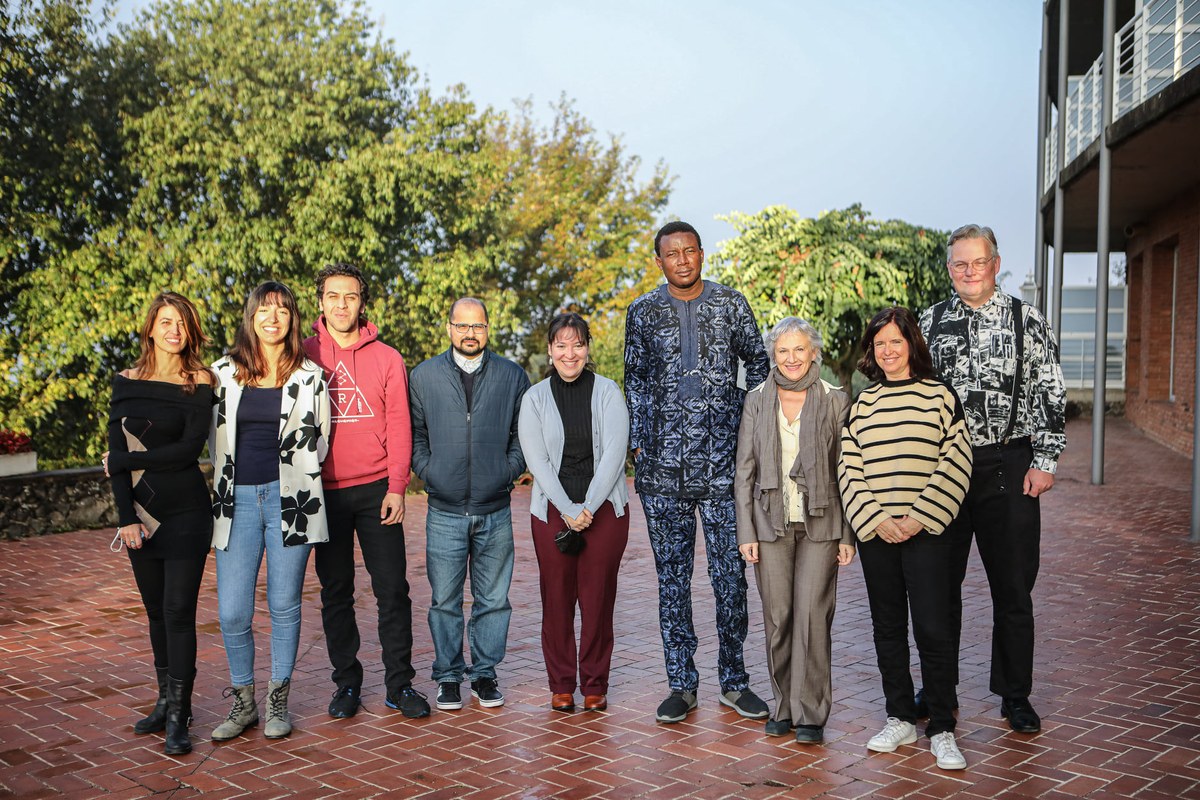
Faber Residency · December 2022
- Interview at the Faber Residency — VideoFaber Llull · 2021
- Dol i Pèrdua de la Meva Llengua — Poetry RecitalFaber Llull · 2021
- Drets Lingüístics — Residency AnnouncementFaber Llull · 2021
- Linguapax Collaboration with Faber Llull on Linguistic RightsLinguapax · 2021
Literary-journalistic platform for new creative writing and journalism from Africa — co-founded by Túbọ̀sún as part of The Brick House Cooperative, a writer-owned media co-op of nine independent publications which he also co-founded in 2020. Túbọ̀sún serves as editor-in-chief and publisher of OlongoAfrica.
In addition to publishing poetry, fiction, essays, and translations, OlongoAfrica has launched its own book imprint (debuting with An African Abroad), produced the Multilingual Anthology for International Mother Tongue Day, and maintained an ongoing archive of the Black Orpheus digitisation project.
Visit OlongoAfrica →Led the 2019 launch of the Nigerian English voice accent on Google Assistant and Google Maps — the first recognition of Nigerian English dialect by a major technology company. Also served as consultant for the Oxford English Dictionary's 2020 inclusion of 29 Nigerian English entries.
The Google launch attracted global coverage. The OED work represented a landmark moment for Nigerian English as a formally documented variety of the language, with entries including words such as danfo, okada, and agbada.
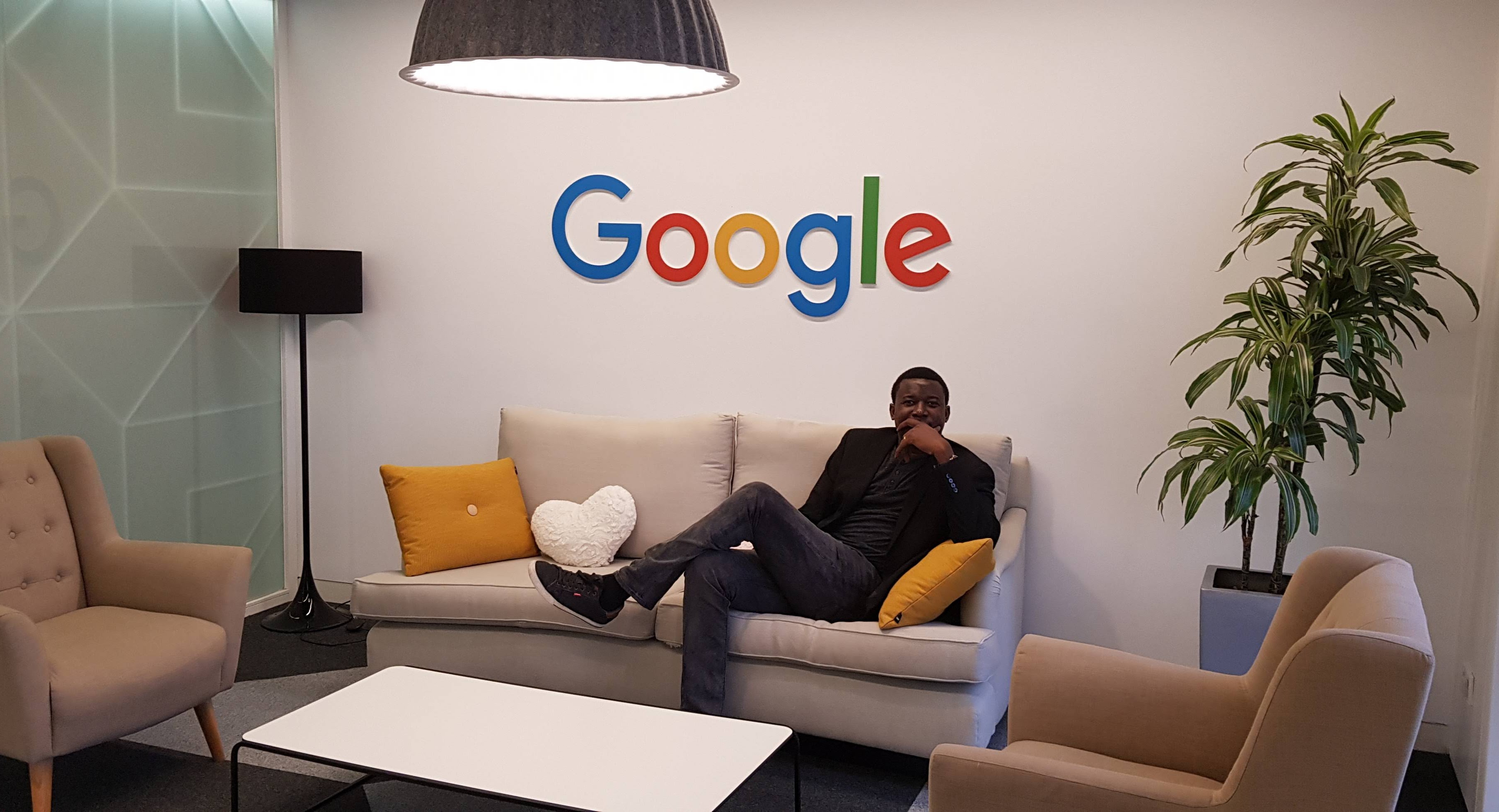
Google offices, March 2019 · © Kọ́lá Túbọ̀sún
Launch day, March 2019 · © Kọ́lá Túbọ̀sún
- How Kola Tubosun and His Team Gave Google a Nigerian AccentTechPoint Africa · 2019
- How Google's Nigerian Voice Accent Was CreatedQuartz Africa · 2019
- On Google's New Nigerian AccentThe World / PRI · 2019
- 29 Nigerian English Words Added to the OEDBBC World Service · 2020
The Yorùbá Names Lexicography Initiative — a Nigerian non-profit working to support the revitalisation of Nigerian languages through technology, archiving, lexicography, and advocacy.
Founded in 2015, the initiative began as a crowdsourced Indiegogo campaign and has grown into four active platforms: YorubaName.com, the first multimedia archive of Yorùbá names with audio pronunciations; IgboNames.com, its Igbo-language counterpart with over 10,000 names and growing; YorubaWord.com, a monolingual dictionary of Yorùbá; and TTSYoruba.com, a text-to-speech tool for Yorùbá. The initiative also produced free Yorùbá and Igbo tone-marking keyboard software for Mac and Windows — enabling millions of speakers to write correctly in their languages on standard devices.
One of the initiative's most consequential acts was the correction of a 180-year-old mistranslation. In Samuel Àjàyí Crowther's Vocabulary of the Yorùbá Language (1843), Èṣù — a major Yorùbá deity — was rendered as "Satan" or "devil," a colonial-era error that propagated through subsequent dictionaries and, eventually, into Google Translate. While working at Google in 2015–16, Túbọ̀sún worked on the first permanent fix of this translation: Èṣù was retained as "Esu" in English, "Demon" became "Ànjọ̀nú," and "Devil" became "Bìlísì." He documented the fix on the YorubaName blog in 2016 and announced the final change on Twitter in May 2019. During his Chevening Research Fellowship at the British Library (2019–20), he handled the original 1843 volume and wrote an essay on the subject for the British Library's Asian and African Studies blog. The entire episode — the mistranslation, the correction, and the encounter with the 1843 volume — became the animating subject of his poetry collection Èṣù at the Library & Other Poems (2024), informally launched at the University of Oxford in 2024. The story was also dramatised in the award-winning Brazilian documentary Èṣù and the Universe (dir. Thiago Zanato, 2022), in which Túbọ̀sún appeared as himself.
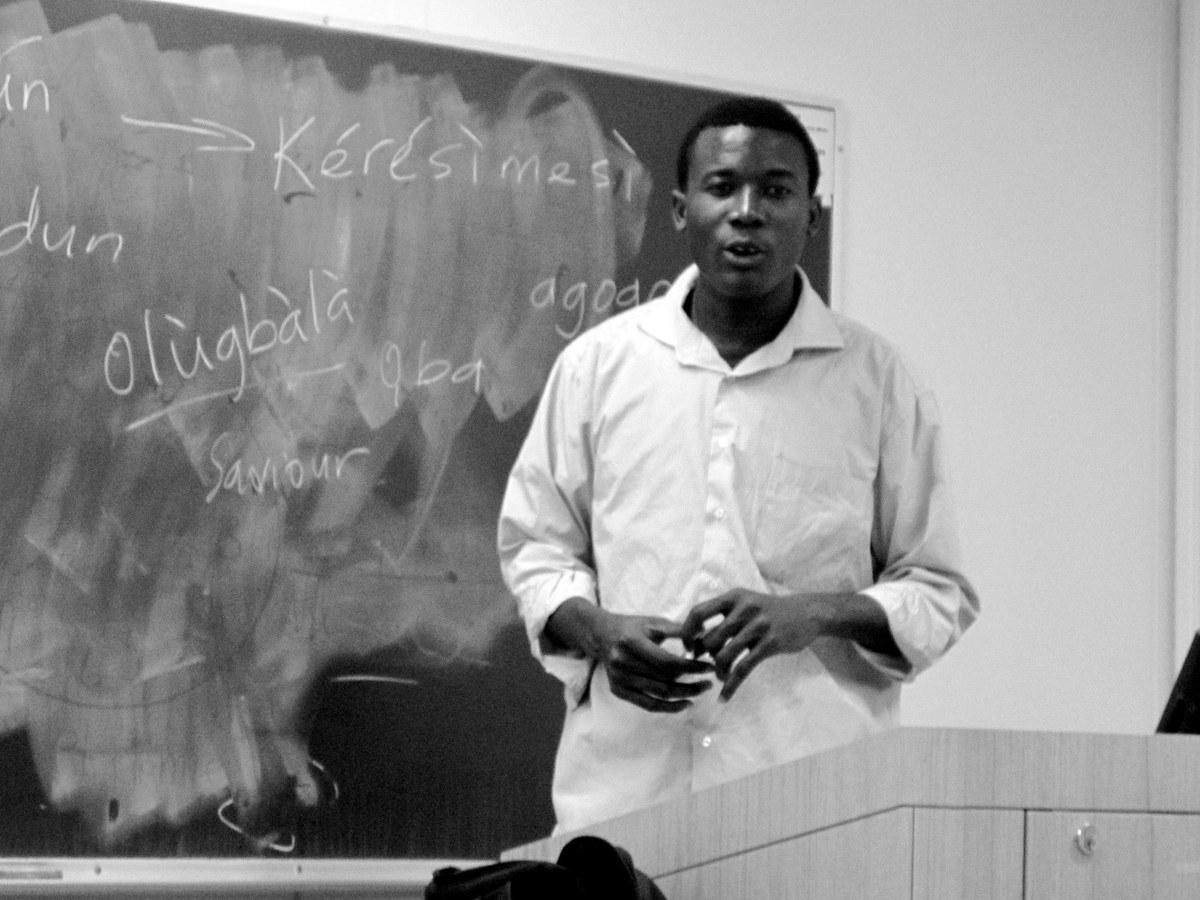
Teaching Yorùbá as a Fulbright Scholar · Southern Illinois University Edwardsville · 2009 · © Kọ́lá Túbọ̀sún
- Preserving Yorùbá and Other African Languages in the Digital AgeBridging The Gap (Podcast) · June 2026
- Èṣù at the Crossroads of AI and Robotics — Leo Akin-OdutolaLinkedIn · April 2026
- In Africa, Rescuing the Languages That Western Tech IgnoresVOA News · 2022
- If We All End Up Sounding Like Americans, You Can Probably Blame Voice AssistantsTechCabal · 2019
- Kola Tubosun, the Man Behind YorubaName.com, Shows Us the FutureTechCabal · 2015
- This Linguist Is Creating An Online Dictionary of Yoruba NamesTechCabal · 2015
- On YorubaName.com, Language, and Digital HumanitiesBrittle Paper · 2016
Audio Course 2017 · With OrishaImage.com
A free multilingual audio course in Yorùbá — 22 lessons in English, Spanish, and Portuguese — created for Olorishas and cultural practitioners of Yorùbá-derived religions across the diaspora.
Produced in collaboration with Moussa Kone of OrishaImage.com, the course covers greetings, compliments, health, food, time, appointments, and much more. It was met with particular enthusiasm in Brazil, where it circulated widely in the Candomblé community, and in Cuba and the United States. All 22 lessons are free to download and share. Covered by OkayAfrica on its release.
Special Prize 2016 · Ostana, Cuneo, Italy
Recipient of the Premio Ostana Special Prize (2016) — the first African to receive the award — for advocacy in indigenous language rights and the preservation of minority languages.
The Premio Ostana is an annual prize awarded in the mountain village of Ostana in the Cuneo Alps, recognising writers, poets, and advocates who work in and for minority and endangered languages. The prize has been awarded to figures including Ngũgĩ wa Thiong'o. Túbọ̀sún received the Special Prize in recognition of his work building digital infrastructure for Yorùbá and other Nigerian languages — YorubaName.com, the keyboard software, and his broader advocacy for African language visibility on the internet.
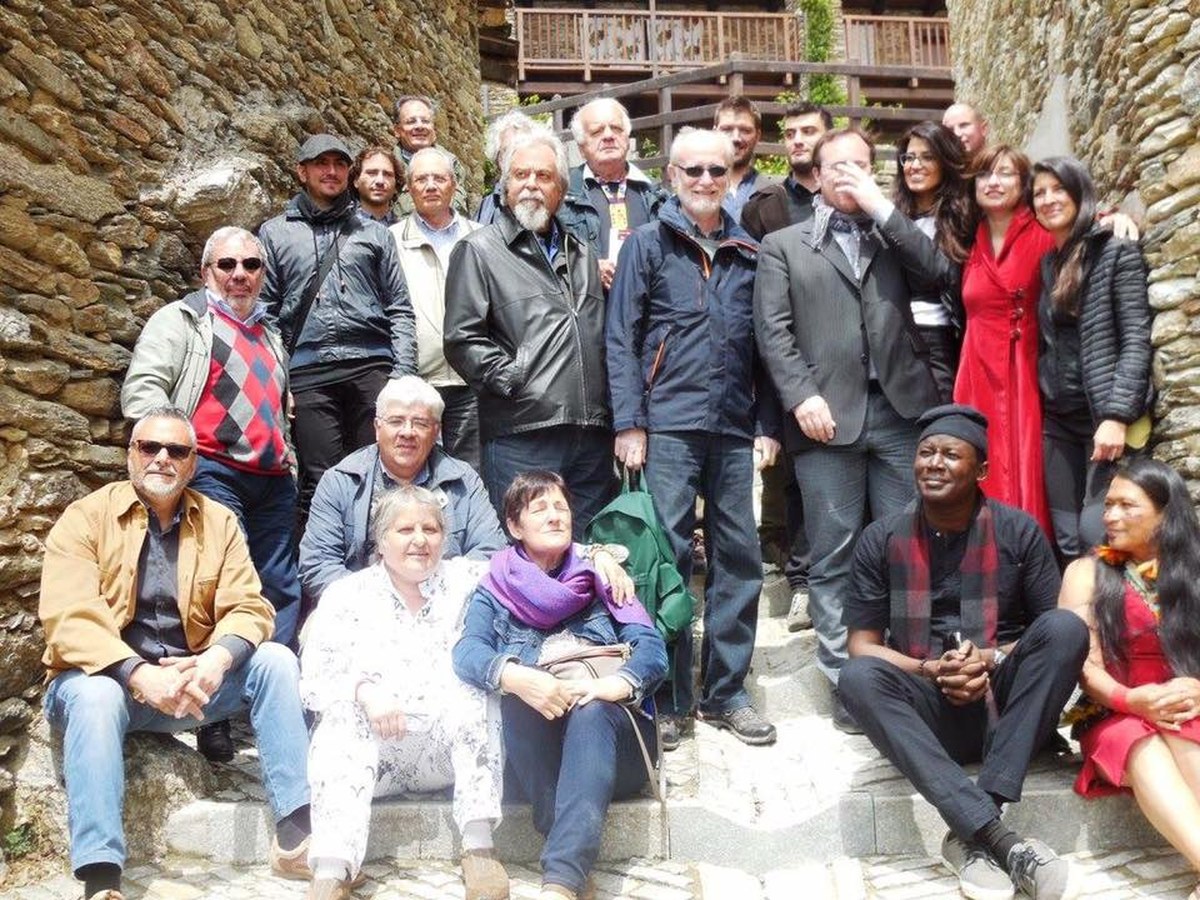
Premio Ostana · Ostana, Cuneo, Italy · 2016 · © Kọ́lá Túbọ̀sún
- Kola Tubosun and the Yorùbá Language — InterviewMargutte · May 2016
- Nigerian Linguist Tubosun Emerges First African to Win Premio Ostana AwardTheCable · 2016
- Nigerian Author Wins Premio Ostana Award for ScripturesThe Nation · 2016
- Lingua Fracas as a Positive — Kọ́lá Túbọ̀súnPremium Times · June 2016
- Premio Ostana 2020 — Programme (English)Chambra d'Òc · 2020
- XIV Premio Ostana — Writings in Mother TongueIDIL · 2022
Led the successful campaign to include Yorùbá as a supported interface language on Twitter — completing translation of the platform's full standard glossary and culminating in the 2014 launch.
The campaign attracted global coverage and inspired similar efforts for other African languages. At the time of launch, Yorùbá became one of the few African languages officially supported as a Twitter interface language, making the platform accessible to millions of Yorùbá speakers in their own tongue.
- Twitter Is Now Available in YorubaTechCabal · 2014
Personal blog and writing archive — home to travelogues, essays, book reviews, and cultural commentary spanning Nigeria, the UK, the US, South Korea, Italy, and Spain.
One of the longest-running personal writing archives by a Nigerian writer online. The site serves as a record of Túbọ̀sún's intellectual and creative development over two decades, and contains writing that predates his formal publication career.
Visit KTravula.com →